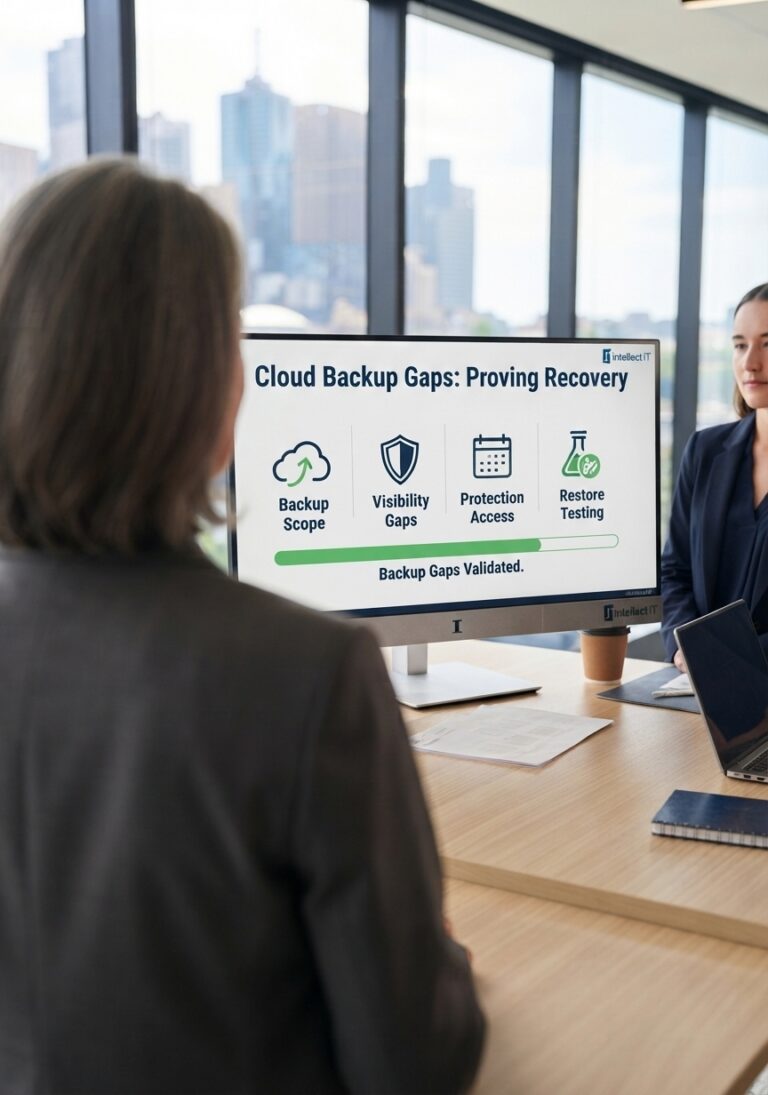
Cloud Backup Gaps: What Native Tools Miss
Cloud backup gaps can leave Microsoft 365, cloud apps and critical data exposed. Learn what native tools miss and how to prove your business can recover.

A timely business continuity lesson for Melbourne organisations relying on cloud systems, phones, payments and multi-site connectivity.
When it comes to Telstra Outage Business Network Resilience, the recent nationwide Telstra outage is a sharp reminder that even Australia’s largest carriers can fail without warning. In this case, the incident has been linked to an obsolete timing server running a known GPS week‑rollover bug, which reset its clock by almost 20 years and pushed incorrect time into downstream systems.
For many organisations, this was not just a telecommunications story. It was a business continuity warning. If your phones, EFTPOS, remote access, cloud systems or multi-site connectivity depend on a single path, a single carrier or a single device, one outage can become everyone’s problem.
Reports point to an older Symmetricom SyncServer S300 timing node, discontinued in 2016, which hit a known GPS week‑rollover defect and rolled its internal clock back by around two decades.
As a director-led Managed Service Provider, Intellect IT helps Melbourne businesses reduce that risk through resilient network design, proactive monitoring and practical continuity planning.
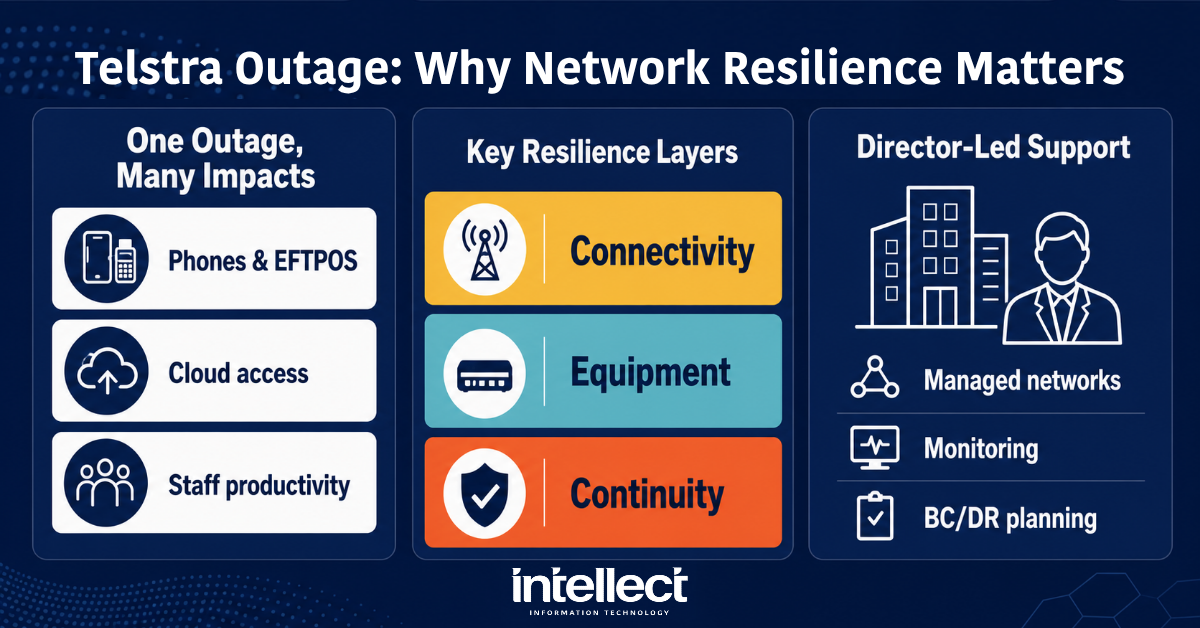
A few years ago, losing internet for an hour might have been an inconvenience. Today, it can mean:
That is why network design should not be reactive. It should be planned around performance, security, future growth and the way your staff actually work across offices, homes, client sites and cloud environments.
Modern networks also depend on accurate timing, security appliances and core infrastructure that must be maintained on a clear lifecycle - not left running on obsolete firmware or hardware until a fault forces an emergency change.
Intellect IT provides managed network services in Melbourne built around resilience, secure connectivity and long-term business continuity.
Our focus includes:
Because our services are director-led, the advice is practical, commercially grounded and tied to how the business actually operates — not just to the hardware in the rack.
The Telstra outage underlined a simple reality: relying on a single internet service or carrier is a risk. Even if that provider is normally reliable, a software defect or network fault outside your control can still bring services down.
For many clients, we design solutions that include:
As part of our managed network services, we do not just deploy these links. We monitor them, test failover behaviour and help clients reduce dependence on one service path.
The Telstra outage was not only about one device failing — it highlighted what can happen when obsolete infrastructure and insufficient timing source diversity intersect. Reports indicate an older Symmetricom SyncServer S300, discontinued in 2016, hit a known GPS week‑rollover bug and rolled its time back by about 20 years.
Because several of these timing nodes were purchased and installed together, they reportedly failed in the same way at the same time. With limited diversity in trusted time sources, downstream systems could not reliably detect and reject the incorrect time, allowing the fault to propagate across the network.
For business networks, the lesson is clear: lifecycle management and source diversity matter. Critical timing, routing, firewall and wireless infrastructure should be monitored, refreshed on a planned cycle, and designed so that no single obsolete device or source can silently influence the entire environment.
Connectivity is only one part of the resilience story. Power events, hardware faults and local infrastructure issues can also bring networks down.
This aligns directly with Intellect IT’s focus on secure wireless and corporate network design for Melbourne businesses that depend on uptime.
A resilient design is only effective if someone is watching it. Under our managed IT services in Melbourne, Intellect IT provides proactive monitoring and management of links, firewalls, switches, wireless infrastructure and broader operational risk points.
The goal is simple: identify outages, bottlenecks, performance degradation and device issues before they create a wider business problem.
Tick the statements that are already true in your business. This gives a quick read on how exposed your current network may be.
One of the most common responses we hear is:
“That sounds great, but what does it cost?”
It is a fair question.
The reality is that the cost of resilience is often far less than the cost of downtime. When evaluating redundancy, businesses should consider:
We often describe resilience as another layer of insurance. Most businesses would never consider operating without insurance for buildings, vehicles or cyber security. Network resilience deserves the same consideration because downtime is no longer just an IT problem – it is a business problem.
If you want to put numbers around that, use the Managed IT Support ROI Calculator to compare the cost of reactive downtime against a more proactive managed services approach.
At Intellect IT, we do not simply recommend resilience to our clients. We continuously invest in our own business continuity and disaster recovery capabilities.
Our Business Continuity Planning framework is built around resilience, redundancy and recovery, recognising that outages, infrastructure failures and service disruptions are inevitable events that organisations must be ready to withstand.
This is one of the clearest ways businesses can assess an MSP: if the provider is not building resilience into their own environment, they are unlikely to prioritise it properly in yours.
If those answers are unclear or heavily reliant on “we haven’t had a problem yet”, it may be time to revisit your current setup with a director-led MSP.
Because it shows how quickly a carrier-level incident can affect phones, EFTPOS, remote access, cloud systems and day-to-day operations. For Melbourne organisations relying on connectivity across offices, hybrid teams and cloud platforms, this is a direct business continuity issue.
It means designing your environment so the business can keep operating when internet services, power, devices or upstream providers fail. That usually includes failover connectivity, redundant equipment, monitoring and continuity planning.
It aligns directly with Managed Network Services Melbourne, Managed IT Services Melbourne, proactive monitoring and Business Continuity and Disaster Recovery. The outage is simply a timely real-world example of why those services matter.
In many cases, yes. The cost of one major outage can outweigh the cost of adding a backup connection, improving network design or introducing more structured managed support. That is also why linking to the Managed IT Support ROI Calculator makes sense in this article.
Review current carrier dependency, identify single points of failure, test failover options, assess monitoring coverage and align the network with business continuity requirements. A network resilience review is usually the best starting point.
If the recent Telstra outage exposed gaps in your current setup, now is the time to address them — not during the next incident.
Intellect IT helps Melbourne businesses improve resilience through director-led managed network services, proactive monitoring and practical continuity planning.
Book a Network Review




Cloud backup gaps can leave Microsoft 365, cloud apps and critical data exposed. Learn what native tools miss and how to prove your business can recover.

Build a cyber resilience strategy that protects critical data, supports ransomware recovery and strengthens business continuity. Speak with Intellect IT.

Scheduling polls in outlook reduce email chains and calendar chasing. See how Microsoft 365 can help your team find meeting times faster.

Comparing Egnyte vs SharePoint file management? See why Melbourne engineering and hybrid businesses choose Egnyte for file governance and hybrid access.
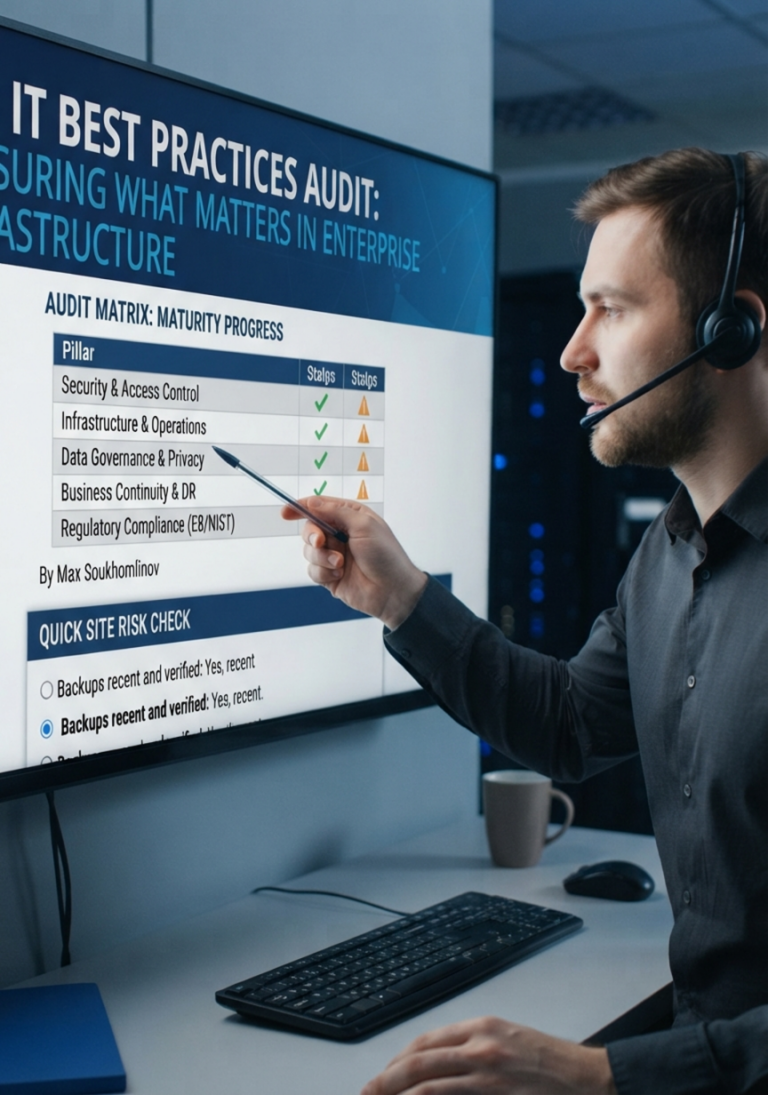
Elevate your enterprise infrastructure with an IT Best Practices Audit. Learn how Intellect IT measures IT maturity, improves security, and drives compliance.

WordPress security services protect business websites from outdated plugins, hacks and downtime. Check your risk, compare patching options and book a human review.