



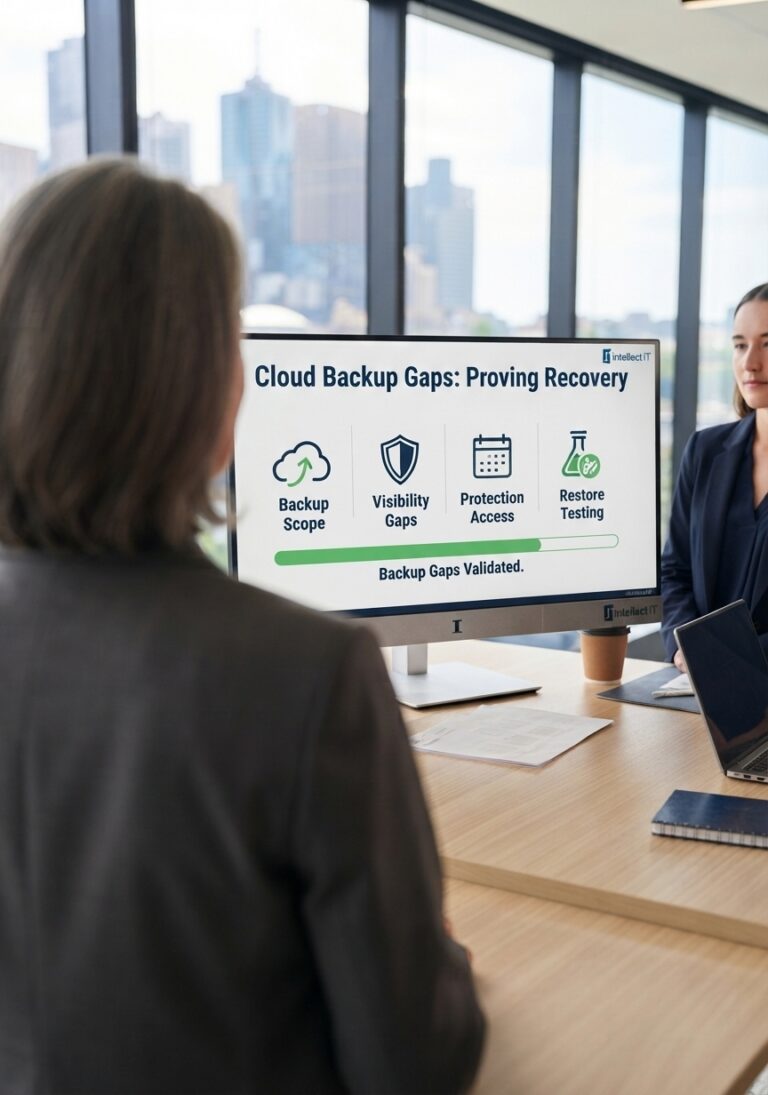
Cloud Backup Gaps: What Native Tools Miss
Cloud backup gaps can leave Microsoft 365, cloud apps and critical data exposed. Learn what native tools miss and how to prove your business can recover.
Stephen Allan | Director-led managed IT services | Approx. 8 minute read
IT hardware procurement typically follows five core phases from initial needs assessment through to refresh and replacement. A structured lifecycle helps businesses reduce risk, control cost, and improve the timing of hardware decisions.
This lifecycle view turns IT hardware procurement from a one-off order into a repeatable business process that can be measured, improved, and aligned with broader IT planning.
IT hardware procurement also needs a fifth step: maintain and refresh. If you are not tracking when devices are heading toward end of warranty, end of support, or end of life, procurement becomes reactive instead of strategic.
While both support the broader technology stack, IT hardware procurement deals with physical assets that must be ordered, shipped, deployed, supported, and eventually retired. Software procurement is usually more focused on licensing, subscriptions, provisioning, and access control.
That difference is why IT hardware procurement should be managed as a lifecycle discipline rather than treated the same way as software buying.
Modern IT hardware procurement works best when it is standardised, measurable, and connected to the broader operating model of the business. That means reducing ad hoc purchasing and building a procurement process that supports forecasting, deployment, and lifecycle control.
These strategies help businesses turn IT hardware procurement into an organised operational capability rather than a series of last-minute purchases.
Historically, many businesses could identify a requirement, collect quotes, secure approval, place an order, and expect the hardware to arrive inside a workable project window. That model becomes much riskier when prices move faster, supply conditions tighten, and procurement decisions get delayed internally. Recent reporting from TrendForce, CRN, and The Register all point to continued pressure across memory pricing and supply.
That is why IT hardware procurement now needs a longer planning horizon. If you leave hardware decisions too late, you compress testing, reduce negotiation time, increase the chance of needing substitutes, and expose the business to avoidable cost and delivery pressure. Broader market commentary from CNBC and Business of Tech has also linked AI infrastructure demand to downstream hardware cost pressure.
Use this calculator to estimate when planning should start based on your target deployment date, evaluation effort, internal approvals, and risk buffer.
Current risk buffer: 2 months
Good IT hardware procurement starts with lifecycle visibility. Your business should know which laptops, servers, firewalls, storage devices, and networking assets are approaching critical milestones so decisions can be made before the pressure becomes urgent.
It also means aligning procurement with budget cycles, approval workflows, deployment timing, and security requirements. The goal is not just to buy equipment. The goal is to buy the right equipment at the right time, on terms that protect the business from unnecessary disruption.
Hardware timing is only part of the equation. If ageing devices, recurring support interruptions, and reactive fixes are already affecting your team, the Managed IT Support ROI Calculator can help estimate the business value lost to downtime, internal coordination, and preventable IT overhead.
For many teams, this is the missing link between IT hardware procurement planning and broader managed IT decision-making. Instead of treating procurement as a standalone purchasing task, you can use the calculator to model the cost of waiting too long to replace underperforming or high-friction devices.
Order when hardware becomes urgent, compare a few quotes quickly, and accept higher risk around price, timing, and substitutions.
This approach usually appears when lifecycle visibility is weak and procurement starts only after a problem becomes urgent.
Start with lifecycle data, evaluate models earlier, work through approvals sooner, and keep more control over cost and delivery.
A planned model treats IT hardware procurement as an ongoing business process rather than a last-minute order.
Use approved device catalogues, standardised specifications, realistic buffers, and clear ownership of quote and approval timing.
These controls make planning repeatable and reduce the operational risk that comes with ad hoc purchasing.
More predictable budgeting, smoother rollouts, less forced compromise, and fewer situations where ageing hardware stays in service too long.
When procurement is planned properly, the benefit is not just lower stress. It improves commercial and operational outcomes.
Tap or click each card to expand the detail and compare reactive purchasing with stronger IT hardware procurement planning.
Answer these quick questions to see where your planning process is strong and where risk may be building.
If your business expects to refresh hardware within the next 12 months, now is the time to review the asset base, confirm what is approaching expiry, and decide which categories need early evaluation. That is the foundation of stronger IT hardware procurement. Deloitte’s hardware and consumer tech outlook and ARN’s coverage of local channel supply pressure add useful market context.
If you are trying to justify refresh timing internally, this is also the right point to pair your procurement roadmap with a financial planning view. The Managed IT Support ROI Calculator can help show what recurring support drag, avoidable downtime, and ageing-device friction may be costing the business each year.
Use these pages to build a stronger content cluster around hardware planning, pricing, and managed IT advice.
If your team is working through a 2027 refresh, infrastructure upgrade, or hardware standardisation project, Intellect IT can help you plan earlier, reduce commercial risk, and make better procurement decisions. You can also use the Managed IT Support ROI Calculator to estimate the broader business cost of delaying critical replacements.
Talk to Intellect ITPractical guidance on lifecycle planning, approvals, pricing risk, deployment timing, procurement strategy, and managed IT cost planning.
IT hardware procurement is the structured process of sourcing, purchasing, deploying, supporting, and refreshing physical technology assets such as laptops, servers, storage, networking equipment, and peripherals.
It has become harder because pricing can move faster, supply conditions can be less predictable, quote validity may be shorter, and businesses often need more lead time to test, approve, and secure the right hardware.
For many refreshes and infrastructure projects, businesses should now plan IT hardware procurement around 12 months ahead instead of relying on a short three-to-six-month ordering cycle.
A strong strategy should include needs assessment, lifecycle visibility, approved hardware standards, vendor evaluation, pricing controls, deployment planning, support alignment, and end-of-life replacement planning.

Cloud backup gaps can leave Microsoft 365, cloud apps and critical data exposed. Learn what native tools miss and how to prove your business can recover.

Build a cyber resilience strategy that protects critical data, supports ransomware recovery and strengthens business continuity. Speak with Intellect IT.

Scheduling polls in outlook reduce email chains and calendar chasing. See how Microsoft 365 can help your team find meeting times faster.