
Is That Really Your Boss on the Phone? How to Stop Deepfake Scams
Deepfake scams use AI voice cloning to impersonate bosses and suppliers. Learn why spotting glitches fails and the 3-step process that protects your business.
Key takeaways – Cyber Security Training for Australian SMBs in 2026
In the current threat landscape, technical infrastructure alone is no longer enough to secure your business. While your firewalls, managed IT services and endpoint protection are essential, the most critical line of defence is often the one you overlook: your people.
Cybercriminals know that employees are busy, distracted and under pressure. They know that if they can create enough urgency, familiarity or fear, they can often bypass even strong technical controls by manipulating a single staff member into clicking, replying, approving or sharing.
That is why cyber security training for Australian SMBs is now a foundational business requirement. It is no longer enough to install security tools and assume the job is done. If your team does not understand how modern attacks work, then your organisation remains exposed at the exact point attackers are most likely to target.
At Intellect IT, cyber security training for Australian SMBs is delivered directly by a director-led team that works every day with Melbourne and Australian businesses facing real-world threats. Rather than generic e-learning, our Cyber Security Training Hub gives your staff structured, practical guidance across nine focused topics that map to how your organisation actually operates.
Each topic is designed to be short, clear and immediately usable, so busy staff can build confidence without needing to become technical specialists. Together, the nine modules form a Human Firewall program that sits alongside your managed services and Essential Eight uplift, turning cyber security from “something IT handles” into a shared, business-wide responsibility.
Because the training is director-led and grounded in current incidents, your team hears directly from people who see the consequences of breaches in Australian SMBs. That context makes the message stick and turns abstract “security awareness” into practical behaviour change in your business.
Cyber security training is no longer an optional “extra”. It is not a nice-to-have, a compliance checkbox or a once-a-year presentation. For Australian small and medium businesses, it is now a core part of operational resilience.
Human error remains one of the primary entry points for cybercriminals. Staff click malicious links, reuse passwords, respond to fake invoices, approve fraudulent payment changes, and enter credentials into convincingly spoofed login pages.
These are not signs that employees are careless; they are signs that attackers have become exceptionally good at exploiting normal business behaviour.
Cyber security training for Australian SMBs directly targets that problem. It gives staff the awareness, language and practical decision-making tools to identify suspicious activity before it becomes a breach. In other words, it creates a human firewall – a layer of live, thinking defence that sits in front of your systems every day.
With the average cost of a cyber incident for Australian small businesses now reaching $56,600, the cost of inaction is no longer theoretical. A single incident can trigger downtime, recovery costs, lost productivity, reputational damage, compliance fallout and customer distrust. For many SMBs, one significant cyber event is enough to seriously disrupt operations.
If your staff are not trained to identify modern scams, then your business can still be breached even when you have good firewalls, secure email, endpoint protection and managed IT support in place.
The Australian Signals Directorate continues to report that a cybercrime incident occurs every six minutes. In 2026, however, the environment has become even more difficult for small businesses because automation and generative AI have changed the quality, speed and scale of attacks.
For independent background on common threats facing Australian small businesses, you can also review the Australian Government’s Small Business Cyber Security Hub , which outlines current risks and baseline controls.
Attackers no longer need to rely on poorly written phishing emails filled with spelling mistakes. They can now use AI to generate polished, context-aware messages that mimic internal email tone, client wording, supplier language and even individual writing habits. That means the usual visual clues staff once relied on are no longer enough.
AI-driven phishing allows cybercriminals to create highly personalised emails in seconds. These messages can reference real invoice cycles, names of team members, current projects or familiar business processes. A request that once looked suspicious may now appear entirely routine.
This makes cyber security training for Australian SMBs even more important. Staff need updated guidance on what to check beyond spelling and tone – such as domain anomalies, unusual login flows, attachment behaviour, abnormal approval requests and subtle patterns that indicate a message is not what it appears to be.
The financial impact of cyber incidents continues to rise. With costs increasing 14% year-on-year, the total cost of a single incident often exceeds the cost of implementing a full year of security awareness training alongside a managed security program.
The direct dollar figure is only part of the problem. Businesses also face lost productivity, emergency remediation costs, potential legal exposure, client churn, staff stress, and the reputational damage that follows when customers lose confidence in your systems or processes.
Social engineering remains one of the most effective attack methods because it targets human trust. Cybercriminals exploit urgency, familiarity, authority and distraction – all common elements of modern work.
They may impersonate a colleague, a manager, a supplier, a customer or a bank. They may ask for password resets, changes to payment details, document access, credential confirmation or urgent wire approvals. In many cases, the attack succeeds not because systems are weak, but because people are pushed into making fast decisions without enough verification.
Technology is a tool; training is the skill. To effectively defend your organisation, you must move beyond occasional reminders and embrace a culture of continuous security awareness.
The Human Firewall concept is simple but powerful: every employee becomes an active part of your defensive perimeter.
Instead of assuming staff are the weakest link, you equip them to become your final verification layer – one that can identify and stop threats that software alone cannot always catch.
This does not mean turning employees into security experts. It means teaching them how to recognise the “tells” of malicious activity in the context of their daily work: unusual requests, suspicious domains, unexpected login prompts, urgent money transfers, strange file sharing behaviour or requests that do not match normal procedure.
At Intellect IT, our methodology is designed to bridge the gap between complex cyber threats and practical day-to-day staff behaviour. We don’t just explain what phishing is. We show how phishing appears in real business environments, how staff are likely to encounter it, and what the correct response should be in that moment.
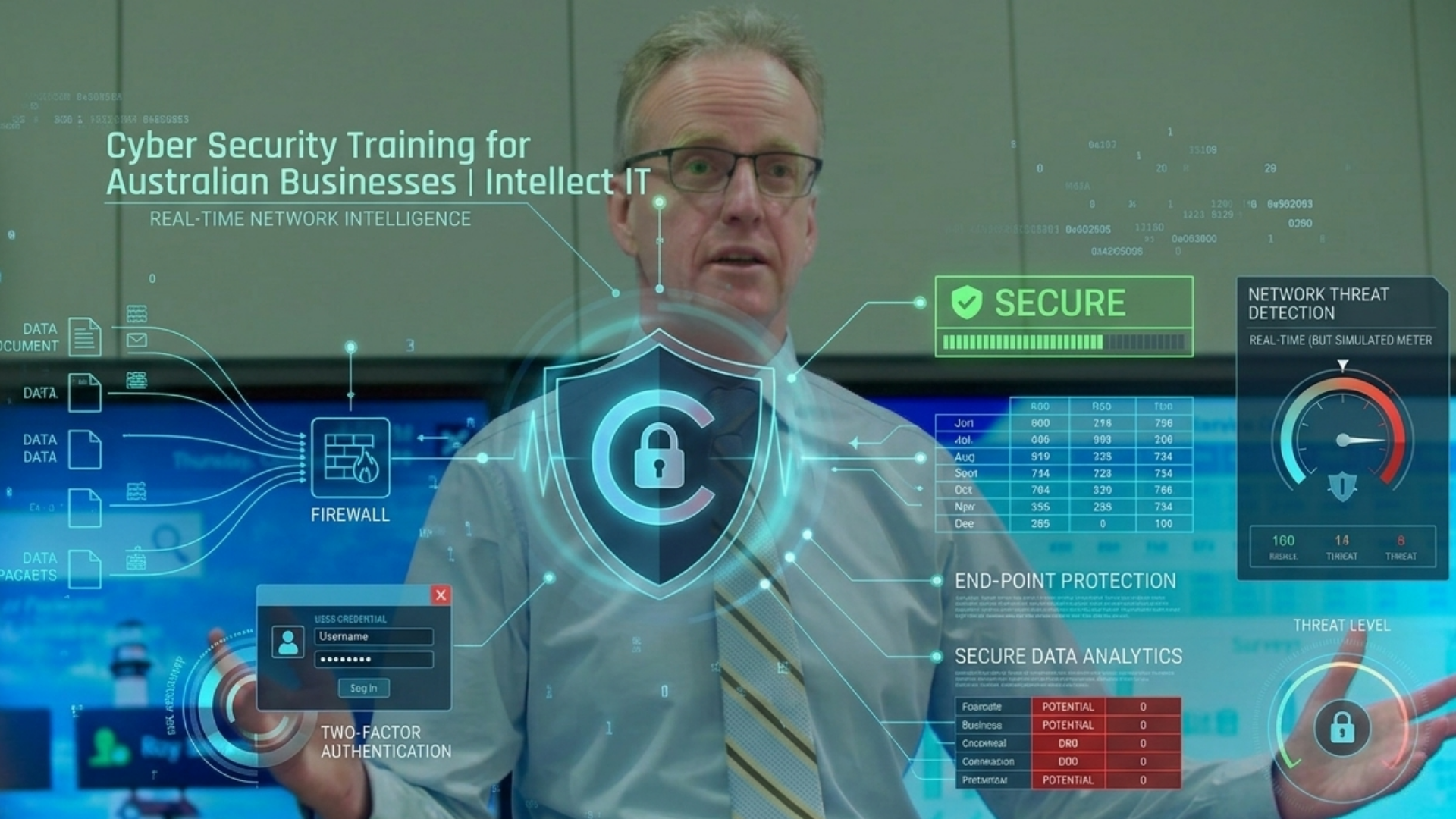
We’ve documented our Human Firewall methodology inside the Intellect IT Cyber Security Training Hub , giving Australian SMBs practical, director-led cyber security training across nine business-critical topics.
It’s designed to help your staff recognise phishing, social engineering, credential risk and modern AI-enhanced scams in the context of real day-to-day operations.
View the 9 training topicsEffective cyber security training for Australian SMBs is practical, repeated and contextual. It should not be limited to generic modules that staff complete once and forget.
Over time, this creates a security-aware culture where people do not simply “hope” something is safe. They pause, validate and escalate with confidence.
Intellect IT is not a set-and-forget provider. As a Melbourne-based Managed Services Provider with more than two decades of experience, we understand that training only delivers value when it connects directly to the systems, policies and managed services already in place across your business.
That is why our approach to cyber security training for Australian SMBs is aligned with the Australian Essential Eight maturity model and integrated into a broader security posture that includes endpoint protection, monitoring, managed IT support and strategic cyber uplift.
Cyber threats evolve quickly, especially as AI becomes more widely used by attackers. Our training evolves alongside them, giving your team relevant guidance rather than outdated awareness material that no longer reflects real-world attack patterns.
Training should not be vague. We focus on measurable progress, reporting and clarity so businesses can see where risk is improving and which teams or departments need further support.
Because Intellect IT also provides managed services and cyber security support, our training is not disconnected from the rest of your environment. It can align directly with your existing monitoring, Microsoft 365 controls, device management, endpoint protection and incident response processes.
Training works best when it is connected to real operational processes. Staff need to know not only what a threat looks like, but also exactly what to do next inside your business.
That combination – awareness, process, technical alignment and local support – is what makes cyber security training for Australian SMBs genuinely effective, rather than just informational.
Don’t wait for a system alert to find out your team was not prepared. Cyber security training for Australian SMBs is one of the most practical and cost-effective ways to reduce risk before an incident begins.
Visit our Cyber Security Training Hub to view our video resources, or contact Intellect IT directly to schedule a security baseline assessment for your business.
Explore Training HubThe most common breach vector remains social engineering, particularly phishing and credential theft. Because attackers now use AI to automate and personalise these attacks, even technically capable staff can be deceived by convincing, context-rich requests.
The Human Firewall concept transforms your employees into the final, active filter for threats. By training staff to identify signs of phishing or social engineering – such as unusual sender details, urgent payment requests, suspicious login prompts or abnormal communication patterns – you create a layer of defence that software alone cannot replicate.
Training requirements vary by industry, but alignment with the ASD’s Essential Eight maturity model is increasingly expected, particularly for businesses handling sensitive client data, regulated information or government-related work. Awareness and access control are now seen as practical essentials, not optional extras.
Australian SMBs are frequently targeted because they often have fewer internal security resources than large enterprises, while still handling valuable financial, client and operational data. Cyber security training helps close that gap by equipping staff to identify and stop threats earlier.
For Melbourne-based businesses looking for structured, video-led education, our Cyber Security Training Hub provides a clear pathway to training your staff and auditing your internal security culture.





Deepfake scams use AI voice cloning to impersonate bosses and suppliers. Learn why spotting glitches fails and the 3-step process that protects your business.

Phishing scams and fake invoices hit Australian businesses hard. Learn 5 red flags, test yourself on a real-looking invoice and the one habit that stops them.

Protect your business from email impersonation, phishing and spoofing with DKIM and DMARC email security. Intellect IT helps Australian organisations configure, monitor and enforce email authentication.

Cloud backup gaps can leave Microsoft 365, cloud apps and critical data exposed. Learn what native tools miss and how to prove your business can recover.
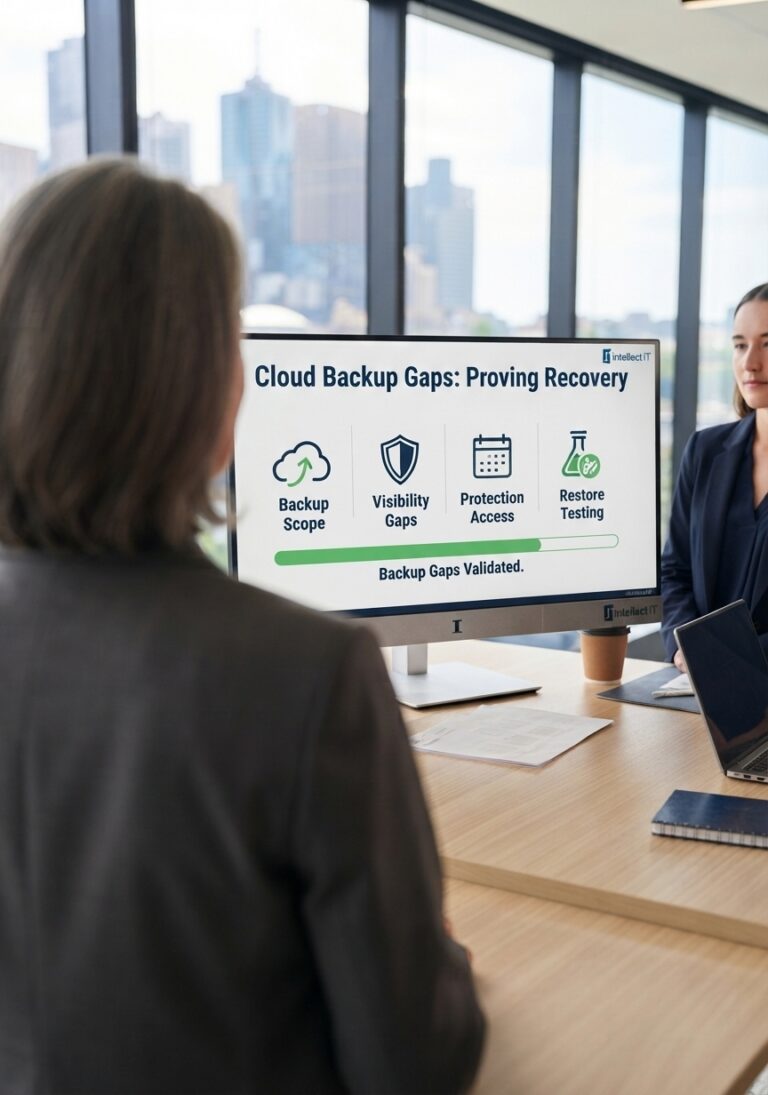
Cloud backup gaps can leave Microsoft 365, cloud apps and critical data exposed. Learn what native tools miss and how to prove your business can recover.

Build a cyber resilience strategy that protects critical data, supports ransomware recovery and strengthens business continuity. Speak with Intellect IT.