
How to Protect Client Data. What Would a Criminal Pay for Your Client List?
Protect client data with three basics: passphrases, a password manager and MFA. Take our 6-question security self-check and see where your business stands.
Why Quotes Vary and Why Cheaper Isn’t Always Riskier. A comprehensive guide to understanding MSP pricing structures, what’s included, and how to make the right choice for your business.
Managed IT services pricing Melbourne businesses see on quotes usually falls into a few common ranges, which are similar to managed IT pricing across Australia.
Managed IT services in Melbourne typically cost between $100 and $280 per user per month for standard support packages. For small to medium-sized businesses (SMBs) with 10–50 employees, this usually translates to a total monthly spend of $1,500 to $8,000, depending on the complexity of the infrastructure and required security levels.
If you’ve ever compared Managed Service Provider (MSP) quotes , you’ve probably asked the same question many Australian businesses do: Why is there such a big difference in price? You might see one provider quoting $50 per user, another $180, and a third somewhere in between — all claiming to deliver fully managed IT.
The reality is simple: MSP pricing varies because MSP maturity, security, and scope vary. And paradoxically, the right MSP can often be cheaper in the long run even if they’re not the cheapest on paper.
For small to mid-sized businesses in Melbourne and across Australia, managed IT services pricing usually falls into a few common ranges, depending on inclusions and security posture.
If you look at recent MSP pricing guides in Australia, Melbourne usually lands in the middle to upper range for managed IT costs. Most providers charge a per-user, per-month fee that wraps in support, monitoring, and security.
Across 2025–2026, those guides generally point to managed IT services in Melbourne starting in the low hundreds per user each month and reaching the mid-$200s for more complete packages. That fits well with the $120–$280 per user, per month range we use here as the realistic "middle ground" for fully managed services.
They also make one thing clear: how you pay can matter as much as how much you pay. Per-user, fixed monthly agreements tend to suit most SMBs that want predictable IT spend, while ad-hoc hourly support can look cheaper on paper but quickly becomes unpredictable when issues spike. That’s why this page focuses on per-user, fixed-fee models rather than break-fix alone.
These are indicative market ranges only - the exact number depends on your environment, risk tolerance, and how all-inclusive you want your agreement to be.
Use this quick estimator to get a rough monthly managed IT cost based on team size, servers, support coverage, security posture, and a few common add-ons. It is designed as a budgeting guide, not a formal proposal.
Understanding how MSPs structure their pricing is crucial for making an informed decision. Use the table below to compare the main pricing approaches used by Australian MSPs.
| Pricing Model | How It Works | Best For | Pros | Cons |
|---|---|---|---|---|
| Break-fix Hourly | Pay when something breaks, hourly fee | Micro/small businesses, startups | No ongoing commitments | No prevention, unpredictable bills |
| Per-Device | Fixed fee per device (PC, server etc.) | Device-heavy environments | Simple to count | Multiple devices = higher cost |
| Per-User / Per Seat | Fixed fee per user covering their kit | Modern cloud-centric businesses | Aligns with headcount | Less ideal for shared devices |
| Fixed Monthly Plan | One flat fee for a defined scope | SMEs wanting fully managed IT | Predictable spend | Needs clear scope |
| Hybrid Model | Base fee + project/hourly extras | Growing SMBs with changing needs | Balance of predictability + flexibility | Potential bill shock on extras |
Most mature MSPs use a per-user, fixed monthly model with clearly defined inclusions and exclusions. This provides the best balance of predictability and comprehensive coverage.
Two MSPs might use the same words — monitoring, support, security — but deliver vastly different outcomes.
| Aspect | Lower-Priced MSPs | Established MSPs |
|---|---|---|
| Approach | Reactive — call us when it breaks | Proactive prevention focus |
| Processes | Heavy manual processes, individual heroics | Automation, proven tooling |
| Documentation | Limited documentation and standardisation | Standardised environments |
| Security | Security as optional bolt-on extra | Security built into core service |
| Risk Profile | Higher long-term risk | Reduced risk and complexity |
One of the biggest pricing differentiators is process maturity. An MSP with documented onboarding and off-boarding, standard operating environments, clear escalation paths, defined SLAs, and proper change control can resolve issues faster, with fewer engineers, less downtime, and less disruption to your team.
Ironically, this is where cheaper can actually be better — an MSP that invests in strong processes can reduce ticket volumes, prevent recurring issues, and deliver consistent outcomes, which lets them price competitively without cutting corners.
Security is another major reason pricing varies so much. Some MSPs offer only basic antivirus and call it security, leave MFA, backups, email security, and monitoring as optional extras, and rely on the client’s existing setup being “good enough.”
Enforce minimum security baselines for all clients, standardise identity, endpoint, email, and backup controls, monitor for threats and anomalies, and actively work to reduce cyber incident and cyber insurance risk.
That investment costs more to run day-to-day, but it can dramatically reduce financial, legal, and operational risk when something goes wrong. When a cyber incident occurs, the cheapest MSP on paper quickly becomes the most expensive decision you ever made.
There’s a factor rarely discussed in MSP pricing: how secure is the MSP themselves? Established MSPs typically invest in secured internal systems, privileged access management, multi-factor authentication across all systems, monitoring of their own environment, and staff security training.
MSPs that don’t invest in their own security can undercut pricing — but they also introduce supply-chain risk that’s hard to see until it’s too late. Your MSP has deep access to your systems, credentials, and data.
When MSP pricing sits at either extreme, risk usually follows. Ultra-cheap MSPs often rely on high volume, shortcuts, or under-scoped services to stay profitable. Premium-priced MSPs can deliver outstanding outcomes, but their level of sophistication and cost isn’t always necessary for every SMB.
An established MSP with strong processes and built-in security can deliver:
No surprise bills or budget overruns.
Proactive monitoring prevents issues before they become problems.
Documented processes and skilled engineers mean quicker fixes.
Security built in, not bolted on.
Protect your business from costly downtime and breaches.

That value zone — not the bargain basement, not the ultra-premium — is where many businesses get the best balance of cost, capability, and confidence.
At Intellect IT, the intention is to sit deliberately in that middle-ground value zone — not as the cheapest provider, and not as the most expensive, but as a best-practice MSP with mature processes and security at the core for Melbourne and Australian businesses.
Our pricing is designed to reflect:
Smooth transitions with minimal disruption.
Consistency and reliability across your infrastructure.
Minimum security baselines built into every package.
Protecting our clients as well as ourselves.
Clear accountability — we do what we say we’re going to do.
When reviewing MSP proposals in Melbourne or anywhere in Australia, it’s tempting to jump straight to the per-user price. Instead, use these questions to compare what actually matters.
When it comes to Managed IT Services Pricing Melbourne price is important — but predictability, security, and trust usually matter more over the life of the contract.
The table below gives a high-level view of how middle-ground MSP pricing can scale with business size. Actual pricing will vary based on tools, locations, and security requirements.
| Business Size (Users) | Typical Needs | Monthly Range Per User | Notes |
|---|---|---|---|
| 10–20 users | Small office, basic cloud and devices | $140–$250 | Focus on stability, backups, essential security |
| 20–50 users | Multi-site or growing team, more line-of-business apps | $130–$230 | Stronger standards, more process/automation |
| 50–100 users | More complex stack, higher compliance expectations | $120–$210 | Gains from standardisation and tooling |
Most managed IT service agreements include proactive monitoring, patching, help desk support, endpoint protection, MFA guidance, backup oversight, and service reporting. Higher-tier plans may also include strategic guidance, compliance support, and after-hours response.
Per-user pricing charges a fixed amount per person and usually covers all the devices that user works on.
Per-device pricing charges separately for each device, which can make sense in device-heavy or shared environments, but can be harder to manage where individuals use multiple devices.
To compare MSP proposals effectively:
Some premium MSPs are aimed at heavily regulated or complex environments and can be a great fit when you have high compliance or risk requirements.
Many SMBs in Melbourne and throughout Australia, however, get better value from a strong mid-priced, process-driven, security-first MSP that focuses on right-sized outcomes rather than enterprise-grade everything.
Get a transparent, no-obligation quote tailored to your Melbourne business needs.





Protect client data with three basics: passphrases, a password manager and MFA. Take our 6-question security self-check and see where your business stands.

Deepfake scams use AI voice cloning to impersonate bosses and suppliers. Learn why spotting glitches fails and the 3-step process that protects your business.
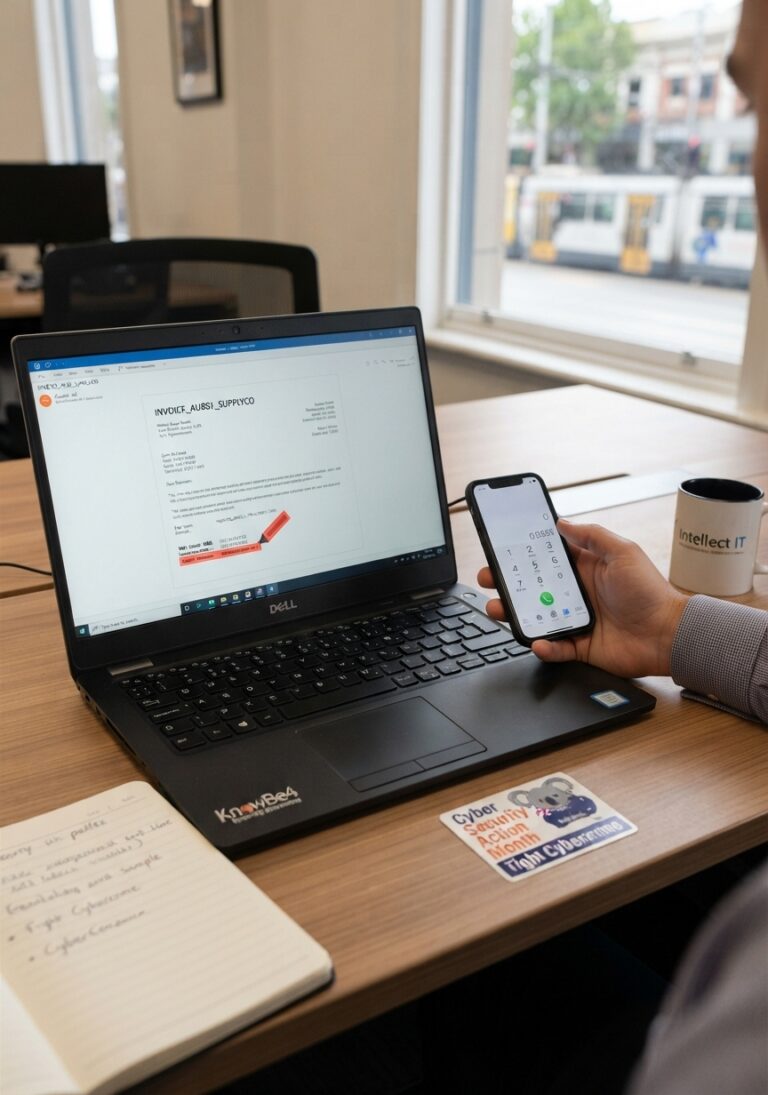
Phishing scams and fake invoices hit Australian businesses hard. Learn 5 red flags, test yourself on a real-looking invoice and the one habit that stops them.