




Why WordPress Security Services Matter More Than Ever for Business Websites
WordPress security services protect business websites from outdated plugins, hacks and downtime. Check your risk, compare patching options and book a human review.
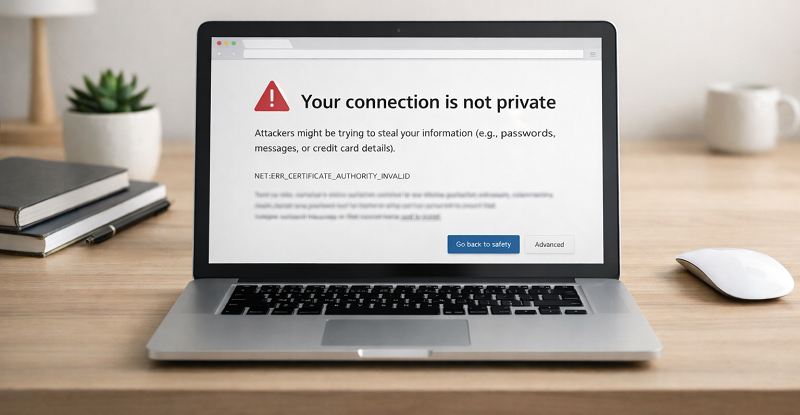
Picture this: a staff portal stops loading mid-morning. A business application that connects two critical systems quietly drops its connection overnight. An integration your finance team relies on – perhaps the link between your POS and your ledger – starts returning cryptic errors. No warning, no countdown, just a total halt in service. In each case, the cause is identical: a security certificate quietly expired, and nobody knew it was even on the radar. What is needed? Automated 47-Day SSL Certificates.
As a Director at Intellect IT, I have spent over two decades overseeing the deployment of mission-critical infrastructure across Australia. I have seen firsthand how minor oversights in technical governance can escalate into significant operational downtime. The shift toward 47-day mandate is not a minor update; it is a fundamental change to the trust architecture of the internet. What is needed? Automated 47-Day SSL Certificates.
Without a transition to automated Certificate Lifecycle Management (CLM), organisations will face frequent "silent outages" that disrupt connectivity and compromise security. At Intellect IT, we focus on identifying these technical gaps now, ensuring your systems are hardened and automated long before the 2026 mandate takes effect.
Melbourne organisations face a critical infrastructure transformation as the CA/Browser Forum's 47-day certificate mandate reshapes digital security across Victoria and Australia. From March 15, 2026, maximum SSL/TLS certificate validity will plummet from 398 days to 200 days, ultimately reaching just 47 days by March 2029.
This seismic shift means Australian businesses must transition from annual certificate renewals to near-monthly automation cycles—a 700% increase in manual workload. For enterprises in Melbourne, internal APIs, VPN gateways, and legacy ERP systems are most vulnerable to silent outages.
How many manual certificates (APIs, Portals, VPNs) do you currently track?
The CA/Browser Forum has confirmed a tiered reduction in certificate lifetimes. This roadmap is the new baseline for global digital trust:
Behind most business systems that communicate securely - whether across the internet or internally within your private network - sits a security certificate. Think of it as a digital licence that confirms a system is legitimate and ensures the data passing through it is encrypted. In my view, it’s the "health certificate" for your server. Without a valid one, systems stop trusting each other, and connections fail instantly. There is no 'grace period' and no 'reduced functionality' mode. The door simply locks.
A global standards body, heavily influenced by Google and Apple, has agreed to dramatically shorten how long these certificates can remain valid. From March 2026, maximum lifetimes will begin reducing in stages.
We are moving from the current ~398 days down to 90 days, and eventually to just 47 days by 2029. The security rationale is sound: a shorter-lived certificate limits the damage if a private key is ever compromised. The window of exposure closes faster. But for most Australian businesses, the security theory isn’t the challenge - the operational reality is.
It’s worth being direct here: the conversation around 47-day certificates often leads with website risk. For most of you, that’s not where the real exposure sits. Modern public-facing websites are typically set up for Automated Certificate Management (ACM). They use protocols like ACME to handle renewals in the background without human involvement. If your website is configured correctly, it simply rolls over. The change in lifetimes accelerates the cycle, but the pipes are already built to handle the flow.
Beyond the certificate lifespan, the Domain Control Validation (DCV) reuse window is collapsing. Currently 398 days, it will drop to just 10 days by 2029.
This is the "Silent Outage" trigger: Manual validation of domain ownership for every internal API and VPN gateway will become an unsustainable daily burden for IT departments. Automation via ACME is no longer an option; it is a prerequisite for uptime.
The systems that don’t automatically renew are the ones that will catch organisations out. These are the undocumented, "set and forget" integrations that have hummed along for years. We are talking about internal business applications, custom-built APIs, legacy infrastructure, and SaaS integrations configured years ago.
In our 22 years of experience at Intellect IT, we’ve found that most organisations don’t have a complete inventory. These certificates live in spreadsheets, or worse, in the head of a former employee. Under an annual cycle, a diligent team can manage the chaos. Under a 47-day cycle, the margin for error effectively vanishes.
Let’s look at the numbers like a business owner would. Consider a mid-sized firm running 20 internal systems. Under the current model, that’s 20 renewal events per year—manageable as routine maintenance. Under 47-day certificates, that same environment generates over 150 renewal events annually.
The task hasn’t changed, but the frequency has.
Every six weeks, you are rolling the dice on a system-wide outage. This is the operational reality that the March 2026 change creates. You need to solve the planning problem before it becomes a crisis management problem.
The shift toward a mandatory Automated 47-Day SSL Certificate lifecycle represents a permanent move away from manual administrative oversight.
When the industry transitions to this tighter window, the time required to generate a CSR, validate the domain, and install the files manually becomes an unsustainable operational burden. For organisations lacking a centralised management platform, an Automated 47-Day SSL Certificate deployment ensures that the renewal process is triggered, verified, and completed in seconds rather than hours.
This is the only way to eliminate the risk of human error that leads to the “silent outages” currently threatening Australian enterprise networks. By adopting an Automated 47-Day SSL Certificate strategy now, you aren’t just following a mandate; you are future-proofing your infrastructure against the next decade of security standards.
The organisations navigating this most smoothly follow a strict three-stage process.
First: Inventory. You cannot protect what you cannot see. We use discovery tools to find every certificate, even the ones buried in legacy code.
Second: Assessment. We determine which systems can be automated and which require a manual "wrap-around."
Third: Monitoring. We implement alerts that surface weeks before an expiry, not hours after an outage. It isn’t a complex project when approached with a clear plan, but it requires prioritisation today.
At Intellect IT, we see this pattern repeat every decade. A technical change arrives with a clear timeline. The organisations that treat it as a strategic planning issue come through it without dropping a single packet of data.
Those that wait for the first "Certificate Expired" error encounter it as a business-critical crisis. We are currently helping our clients conduct these audits ahead of the March 2026 deadline. If you want a plain-English, technical assessment of where your systems stand, my team is ready to help you bridge the gap.
Subscription Stability: Most CAs (DigiCert, Sectigo) will maintain annual pricing models. You aren't paying more for certificates; you are paying more in labor hours.
Quantum Readiness: This shift forces "Crypto Agility." Shorter lifespans allow organizations to rotate to post-quantum standards in weeks rather than years.
Oversight: Roy Solterbeck | Melbourne, VIC
Don't let an Automated 47-Day SSL Certificate requirement catch your IT team off guard. We help Melbourne businesses bridge the gap between legacy infrastructure and modern automation.
WordPress security services protect business websites from outdated plugins, hacks and downtime. Check your risk, compare patching options and book a human review.

Learn how to migrate your file server to SharePoint Online, choose between lift‑and‑shift or planned migration, and bring your people along with minimal disruption.
Telstra outage business network resilience is now a board‑level issue. Learn how director‑led managed IT services from Intellect IT protect phones, payments and cloud apps when major carriers go down.