Quantum Computing Is Coming: Are You Ready?
The landscape of modern technology is about to experience a shift more profound than the advent of the internet or the rise of Artificial Intelligence.
At Dreamforce 2025, Alphabet CEO Sundar Pichai delivered a forecast that has sent ripples through the global tech community: commercially viable, scalable quantum computing is no longer a “future” concept – it is a “near-term” reality.
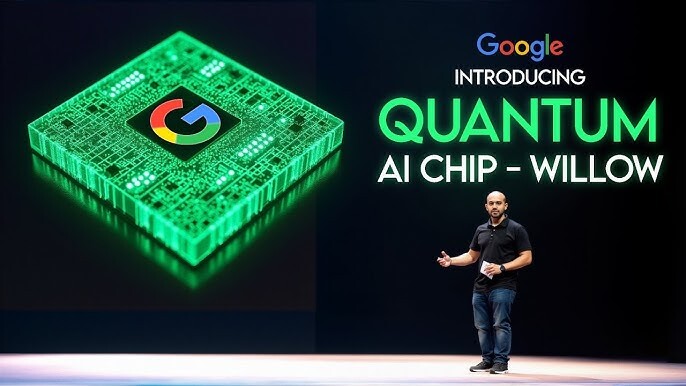
The catalyst for this urgency is Google’s Willow quantum chip. In a recent demonstration, the Willow chip completed a complex error-correction task in just five minutes.
To put that into perspective, the world’s most powerful classical supercomputer would have required 10 septillion years to finish the same calculation.
While this represents a monumental leap for human innovation, it also signals a looming expiration date for the encryption methods that currently protect every bank account, medical record, and corporate secret on the planet.
What is Quantum Computing? A Deep Dive for the Modern Business
To understand why quantum computing is so disruptive, we must look at how it differs from the computers we use today.
Classical computers, whether they are the smartphone in your pocket or a massive server farm, operate on bits. A bit is binary – it is either a 0 or a 1. Every email you send and every password you save is essentially a massive string of these “ons” and “offs.”
Quantum computing operates on qubits. Thanks to the principles of quantum mechanics, qubits can exist in a state of superposition, meaning they can represent 0, 1, or both simultaneously.
Furthermore, through a process called entanglement, qubits can be linked together so that the state of one instantly influences the state of another.
This allows a quantum computer to explore millions of possible solutions to a problem at the same time. While a classical computer must check every “door” one by one to find a key, a quantum computer can check every door in the building at once.
This capability is what makes it a revolutionary tool – and a catastrophic threat to digital security.
The Double-Edged Sword of Quantum Computing: Innovation vs. Vulnerability
Quantum computing is undeniably a “Double-Edged Sword.” On one side, it will unlock breakthroughs that were previously thought impossible:
• Pharmaceuticals: Simulating molecular interactions to discover life-saving drugs in days rather than decades.
• Logistics: Solving the world’s most complex supply chain and optimisation problems instantly.
• Climate Science: Creating new materials for carbon capture and hyper-efficient batteries.
However, the “other side” of the sword is pointed directly at our security infrastructure. As Salesforce CEO Marc Benioff noted during his 2025 fireside chat with Pichai, quantum computers will eventually be able to solve the mathematical problems that underpin RSA (Rivest-Shamir-Adleman) and ECC (Elliptic Curve Cryptography).
These are the two primary pillars of current encryption. When they fall, the “lock” on our digital world effectively disappears.
Why You Need to Act Now: The “Harvest Now, Decrypt Later” Threat
Many business owners in Melbourne and across Australia believe they can wait until a “Cryptographically Relevant Quantum Computer” (CRQC) is physically sitting in a data centre before they upgrade their security. This is a dangerous misconception.
Adversaries – including state-sponsored actors and sophisticated cyber-criminal syndicates – are currently engaging in a strategy known as “Harvest Now, Decrypt Later” (HNDL).
They are intercepting and storing vast amounts of encrypted sensitive data today, even though they cannot read it yet. They are simply waiting for quantum technology to mature so they can run that stored data through a quantum processor and unlock it.
If your business handles data with a long “confidentiality shelf life” – such as intellectual property, long-term financial records, or sensitive client health data – that data is already at risk.
The Vulnerable Infrastructure
Most organisations are currently using aging cryptography throughout their digital assets. These include:
• Network Security: VPNs and Wi-Fi encryption (WPA3).
• Device Protection: BitLocker on laptops and mobile device management.
• Authentication: Digital signatures and SSL/TLS certificates for websites.
• Identity Management: Password hashing and administration protocols.
The Roadmap to Post-Quantum Cryptography (PQC)
The Australian Signals Directorate (ASD) and the Australian Cyber Security Centre (ACSC) have recognised this urgency. In their 2025 guidance, they shifted from “awareness” to “action,” urging Australian businesses to adopt Post-Quantum Cryptography (PQC) – a new generation of mathematical algorithms designed to be resistant to quantum attacks.
The NIST (National Institute of Standards and Technology) has already finalised the first set of PQC standards, including FIPS 203 (ML-KEM) and FIPS 204 (ML-DSA). These are not just “updates”; they are entirely new ways of securing data.
The ASD Transition Timeline
To remain compliant and secure, the ASD’s Information Security Manual (ISM) suggests the following milestones:
| Milestone | Strategic Objective |
|---|
| By End of 2026 | Discovery & Planning: Conduct a full cryptographic inventory of all systems. Identify where public-key encryption is used. |
| By End of 2028 | Implementation Phase: Begin migrating high-priority, long-lived data and critical infrastructure to PQC-standard algorithms. |
| By End of 2030 | Full Transition: Complete the move to ASD-approved post-quantum algorithms across the entire enterprise. |
| Post-2030 | Validation: Continuous monitoring and “crypto-agility” (the ability to swap algorithms quickly as new threats emerge). |
How Intellect IT Can Future-Proof Your Business
At
Intellect IT, we believe that preparing for the quantum shift is not just a technical challenge—it is a strategic necessity. As a leading IT services provider in Melbourne, we specialise in helping businesses build “Quantum-Resistant” foundations.
Our transition process includes:
- Cryptographic Inventory: We use advanced discovery tools to map every instance of vulnerable encryption in your network, from your cloud storage to your onsite hardware.
- Risk Assessment: We prioritise your data based on its “confidentiality shelf life,” ensuring that your most valuable assets are protected against “Harvest Now, Decrypt Later” attacks first.
- Vendor Management: We work with your software and hardware suppliers to ensure their roadmaps align with NIST and ASD standards.
- Implementing Crypto-Agility: We help you move away from hard-coded encryption toward a flexible architecture where security protocols can be updated without rebuilding your entire system.
Future-Proof Your Security Today
Quantum computing is no longer a distant possibility; it is an imminent reality. While the full commercial rollout may take a few more years, the window for securing your data is closing.
Contact Intellect IT today to arrange a quantum-readiness session with our Melbourne technical
team.
• Phone: 1300 799 165
Roy Solterbeck is a Director and Co-founder of Intellect IT. Since co-founding the company in 2003, Roy has established himself as a prominent voice in the Melbourne technology sector.
With over 22 years of experience in technical architecture and IT strategy, he has guided hundreds of organisations through major technological shifts – from the move to virtualisation and cloud computing to the modern challenges of AI and quantum readiness.
Roy is a firm believer in “accumulated knowledge” and “vendor-agnostic” solutions. His leadership ensures that Intellect IT provides impartial, expert-led guidance that prioritises the client’s long-term resilience over short-term trends.
Under his direction, Intellect IT has maintained a 4.9-star Google rating and a near-perfect CSAT score, reflecting his commitment to technical excellence and client trust.