Skip to content

The IT Best Practices Audit: Measuring What Matters in Enterprise Infrastructure

Elevate your enterprise infrastructure with an IT Best Practices Audit. Learn how Intellect IT measures IT maturity, improves security, and drives compliance.

At a glance

Core takeaway – IT audit best practices
An IT Best Practices Audit is not just a checklist – it is a strategic governance tool designed to assess and elevate IT maturity, security compliance, and risk resilience across your entire organisation.
Key subject
IT maturity framework, infrastructure governance, security compliance audit, and risk mitigation.
Target audience
Business owners, IT directors, and operations leaders responsible for enterprise technology.
Estimated scope
Depends on organizational size, infrastructure complexity, cloud footprint, and compliance requirements.
IT Best Practices Audit by Intellect IT
Need an IT Audit?
An IT Best Practices Audit is much more than a checklist - it’s a strategic governance tool which assesses your IT maturity, security compliance, & risk resilience

QUICK ANSWER

What is an IT Best Practices Audit?

An Information Technology (IT) Best Practices Audit is a systematic review of an organization’s technology infrastructure, policies, and operations to ensure security, efficiency, and regulatory compliance. This process helps identify vulnerabilities, optimize system performance, and align technology goals with broader business objectives.

WHAT TO KNOW FIRST

Key takeaways

  • Maturity is a process, not a destination. True IT maturity requires continuous measurement and adaptation rather than a one-off configuration check.

  • Holistic coverage matters. An effective audit evaluates both managed services and internal or third-party IT operations to eliminate blind spots.

  • Visibility precedes security. You cannot protect what you do not measure; comprehensive audits expose hidden configuration drift and shadow IT.

  • Actionable roadmaps drive results. The ultimate value of an audit lies in turning raw compliance scores into a prioritized execution plan.

Why an IT Best Practices Audit matters for enterprise infrastructure

True IT maturity goes beyond simply deploying services—it requires a continuous, measurable governance framework. For growing organisations, technology drift is a constant risk. Without structured oversight, security gaps widen, cloud configurations drift from best practices, and visibility into operational resilience drops. An IT Best Practices Audit eliminates this ambiguity by providing a clear, quantifiable baseline.

Key pillars of an IT Best Practices Audit

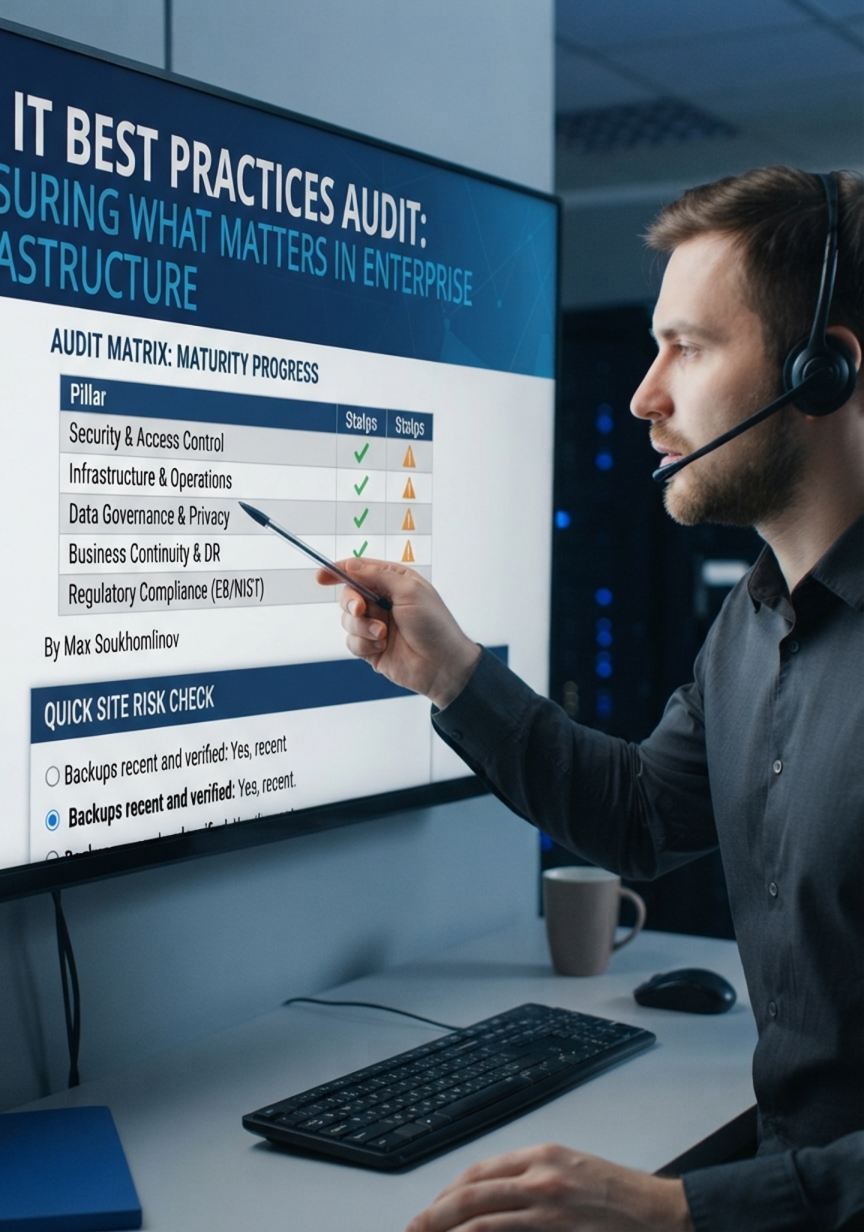
An effective IT audit should thoroughly evaluate five core areas:
  • Security & Access Control: Verifies the deployment of multi-factor authentication (MFA), password enforcement, network firewalls, and the principle of least privilege.
  • Infrastructure & Operations: Assesses hardware lifecycle, software patch management routines, network performance, and configuration management.
  • Data Governance & Privacy: Evaluates data lifecycle management, storage compliance, encryption at rest and in transit, and access log tracking.
  • Business Continuity & Disaster Recovery: Reviews data backup schedules, storage isolation, and systemic testing of failover procedures.
  • Regulatory Compliance: Measures alignment with industry standards such as ISO 27001, SOC 2, NIST, GDPR, HIPAA, PCI-DSS, or local Australian frameworks like the ACSC Essential Eight.

The step-by-step audit workflow

Executing an IT audit requires a structured workflow to maintain accuracy and prevent disruption:
  • Step 01
    Scope & Plan
  • Step 02
    Gather Data
  • Step 03
    Test Controls
  • Step 04
    Analyse Gaps
  • Step 05
    Report & Fix
  • Scope and Plan: Define the exact systems, networks, and compliance frameworks to evaluate based on your organization’s risk appetite.
  • Gather Information: Collect vital materials, including network diagrams, current security policies, user access lists, and asset inventories.
  • Test Controls: Observe operational routines, interview staff, check system configurations, and run automated vulnerability scanners.
  • Analyse Gaps: Compare current performance and data against baseline standards to pinpoint critical risks, missing controls, or compliance gaps.
  • Report and Remediate: Publish prioritized, risk-rated recommendations for executive stakeholders and track the remediation of findings.

Comprehensive coverage domains

Building on core audit pillars, the evaluation spans seven technical domains:
  • Cloud & Server Infrastructure: Validating architecture, scalability, and resource utilization.
  • Office Infrastructure & Cabling: Ensuring physical layer reliability.
  • Endpoint & Network Protection: Reviewing firewalls, endpoint detection, and patch management.
  • Policy & Compliance: Aligning internal security policies and access controls with recognized frameworks like the ACSC Essential Eight and NIST guidelines to satisfy cyber insurance and vendor due diligence requirements.
  • Business Continuity: Testing backup integrity, disaster recovery plans, and failover readiness.
  • End User Device Management: Standardizing mobile and workstation deployments.
  • Microsoft 365 Best Practices: Hardening tenant settings, enforcing Multi-Factor Authentication (MFA), and optimizing SharePoint governance.

Real-world impact: From risk to resilience

An audit is only as good as the action it drives. This framework provides an executive roadmap tailored to each organization—prioritizing critical remediations such as transitioning to Microsoft 365 Business Premium, deploying advanced SIEM/SOC monitoring, or hardening identity management layers. Organizations leveraging this continuous audit cadence experience:
  • Minimized Attack Surface: Proactive identification of vulnerabilities before exploitation.
  • Operational Predictability: Streamlined infrastructure that reduces downtime and support ticket volume.
  • Auditable Compliance: Clear metrics for board reporting, cyber insurance renewals, and vendor due diligence.

Common pitfalls

The most common mistake is treating an IT audit as a one-off compliance exercise rather than an ongoing operational habit. Other pitfalls include ignoring edge devices, failing to tie audit scores to executive budgeting, and treating security policies as static documents. A better approach is to integrate the IT Best Practices Audit directly into quarterly governance reviews.

Ad-Hoc IT Reviews vs Structured IT Best Practices Audit

Factor Ad-Hoc IT Reviews Structured IT Best Practices Audit
Scope Fragmented / Reactive Comprehensive / Proactive
Scoring Subjective Quantifiable (Non-Compliant to Full Compliance)
Outcome Temporary fixes Strategic maturity roadmap
Best Suited For Small, isolated setups Business-critical enterprise environments

Plugin-only vs managed security service

Factor Plugin-only Managed security service
Setup cost Low Higher, but covers response
Ongoing responsibility Stays with site owner Handled by provider
Incident response DIY Defined recovery process
Best suited for Small, low-risk sites Business-critical sites
OUR DELIVERY MODEL

What happens during an IT Best Practices Audit engagement?

 
1

Phase 1 – Assess and baseline the environment

  • Review the full stack: We evaluate servers, cloud tenants, endpoints, and networking hardware to establish your current operational baseline.
  • Evaluate policy compliance: We inspect access controls, data sovereignty alignment, and internal security policies.
  • Map risk exposure: We identify high-priority vulnerabilities and configuration drift across all technical domains.
2

Phase 2 – Map to industry benchmarks

  • Score performance: We grade each domain from non-compliant to full compliance against proven industry standards.
  • Prioritise gaps: We isolate critical operational risks that require immediate remediation.
  • Align future states: We define your target operating model based on enterprise best practices.
3

Phase 3 – Deliver the executive roadmap

  • Build the action plan: We generate a prioritized, phased roadmap for infrastructure upgrades, security hardening, and policy updates.
  • Resource planning: We match recommendations to internal team capabilities and managed service scopes.
4

Phase 4 – Monitor and iterate

  • Track progress: We review compliance scores continuously to measure maturity growth over time.
  • Refine controls: We update audit criteria as the threat landscape and business objectives evolve.

A successful IT audit is not just a one-time check; it is a continuous baseline for organisational resilience and technological maturity.


Interactive check

Infrastructure Readiness Check

Answer a few quick questions to gauge your organization’s infrastructure readiness.

Are your cloud and server configurations mapped to a formal baseline?

Do you have clear visibility across both managed and internal IT assets?

Is your disaster recovery plan tested and verified annually?

Are M365 and endpoint security settings continuously hardened?

Your current maturity tier

Answer all four questions to see your directional score.

This is a quick directional check, not a full technical audit.

Lead-in action

IT maturity and infrastructure scan

Uncover hidden configuration gaps and security blind spots before they impact operations.

Click the button below to start the check.

Explore our broader Managed IT Services framework. View managed services

Business impact

IT downtime & risk calculator

Estimate the financial exposure of unmitigated infrastructure drift.

Estimated outage impact

$2,167

Combined financial exposure from lost revenue, staff downtime, and emergency remediation.

Lost revenue $0
Productivity loss $0
Recovery labour $0
Emergency spend $0

Fast answers

Common questions

Audit questions – tap a question for a short answer.

How long does an IT Best Practices Audit take?
Most initial assessments are completed within a structured multi-week window depending on enterprise scale.
Does the audit disrupt daily operations?
No. Assessments are conducted via non-intrusive architectural reviews, configuration analysis, and stakeholder interviews.
Who oversees the audit execution?
Every audit is directed by senior engineering leadership to ensure enterprise-grade accuracy.

Decision support

Governance options compared

Choose an evaluation path to see what it delivers in terms of depth, clarity, and accountability.

Low cost, but prone to internal blind spots and subjective grading.

How Intellect IT can help

At Intellect IT, we help businesses measure what matters without adding administrative drag. We focus on practical, director-led interventions that improve security, support recovery, and fit the way your team actually works. That can include conducting a comprehensive IT Best Practices Audit, tightening multi-cloud governance, refining your Cyber Security Solutions, and establishing a clear, repeatable roadmap for long-term IT maturity. The result is a cleaner, more resilient technology environment that is easier to trust, easier to govern, and fully aligned with your business goals.

QUESTIONS, ANSWERED

Frequently asked questions

If you’re evaluating your organization’s governance maturity, these are the questions that matter most:

It provides an objective, quantifiable view of your IT maturity, replacing guesswork with a clear roadmap to reduce risk and elevate operational performance.

Our framework evaluates the entire technology ecosystem – assessing both Intellect IT’s managed scope and your internal operations to ensure complete visibility.

Clients utilizing our structured audit cadence routinely see compliance and maturity scores advance from sub-50% baselines to over 80–90%.

Yes. Our governance frameworks map your infrastructure against recognized standards like NIST and the Australian Essential Eight to satisfy compliance, cyber insurance, and board reporting requirements.

You can request your IT Best Practices audit evaluation or reach out directly to your account manager, Max Soukhomlinov, at Intellect IT.

Ready when you are

Ready to experience
IT that just works?

Talk to an IntellectIT specialist. No obligation, no sales pitch, just honest advice for your business.